
In academic writing, it is vital to present original thoughts, trustworthy research, and accurate references. For students working on college projects, research articles, or theses, upholding academic ethics is critical. Turnitin is a well-known resource utilized by educational institutions to examine written submissions, detect similarities with existing materials, and promote ethical writing practices.
Numerous students are curious about the functionality of Turnitin, the significance of its similarity percentage, and its ability to identify AI-produced content. Gaining insight into these aspects aids students in accurately understanding reports and enhancing their academic writing skills.
This comprehensive guide clarifies what Turnitin is, how its similarity checking system functions, how to interpret the findings, and how learners can utilize feedback for creating improved assignments.
What Is Turnitin?
Turnitin is a technological platform geared toward promoting academic integrity, evaluation, and writing improvement. Educational institutions, including schools, colleges, and universities, utilize its features for assessing assignments and offering feedback.
A prominent aspect of Turnitin is its Similarity Report, which points out text that corresponds with information within Turnitin’s comparison database. Depending on the specific service and institutional preferences, this database may encompass internet resources, scholarly articles, and previously submitted student assignments.
Turnitin aids educators in spotting sections that may need additional scrutiny. Nonetheless, it does not automatically conclude if a student has engaged in plagiarism. A section that matches may be a correctly attributed quote, a phrase commonly used, or text that requires proper reference.
Thus, the report should be considered as a tool for analyzing written material rather than a definitive judgment on academic violations.
How Does Turnitin Work?
The procedure for using Turnitin typically includes several stages.
1. Assignment Submission
Students upload their assignments through a college’s learning management system or any approved submission methodology. The access and submission protocols may vary by educational institution.
2. Text Comparison
Turnitin assesses the submitted document against the content available in its comparison sources. The system highlights portions that resemble present material.
3. Similarity Report Generation
Following the comparison, the system creates a report that displays an overall similarity percentage while highlighting sections that match. Source information may also be included to assist reviewers in examining the similarities.
4. Review and Feedback
Teachers or students examine the highlighted sections, where access is granted, to ascertain the accuracy of citations and determine if any parts need revision.
This procedure can foster improved writing habits by enabling students to identify citation issues and comprehend how their work connects to existing scholarship.
What Is a Turnitin Similarity Score?
The Turnitin similarity score indicates the percentage of a submitted document that corresponds with content within the comparison database. It is represented as a percentage, but it does not serve as a direct measure of plagiarism.
For instance, a paper that has a 20% similarity score includes matching text recognized by the system. That score alone does not indicate whether the paper breaches academic standards.
The matches may consist of citations, properly referenced quotes, commonly used phrases, or earlier submissions of the same paper. In certain instances, they might reveal copied passages that necessitate attention.
What Is a Good Turnitin Score?
There is no single acceptable percentage of similarity that applies universally to every task. Various educational institutions, educators, and types of scholarly assignments might possess distinct criteria.
A research document that incorporates numerous accurately quoted passages could present a greater similarity index than an assignment focused largely on unique analysis. Conversely, a reduced score does not ensure that all concepts have been correctly credited.
Learners ought to assess the specific instances of similarity and adhere to their institution’s protocols instead of concentrating solely on the overall similarity figure.
What Causes a High Similarity Score?
An elevated score can stem from multiple reasons:
Frequent inclusion of quotes from established publications.
Text that matches entries in the reference section or bibliography.
Widespread academic phrases or specialized language.
Earlier versions of identical assignments submitted previously.
Sections that closely mimic online articles or scholarly journals.
The most effective strategy is to scrutinize the highlighted sections and rectify any legitimate citation or writing problems.
Is AI-Generated Content Detectable by Turnitin?
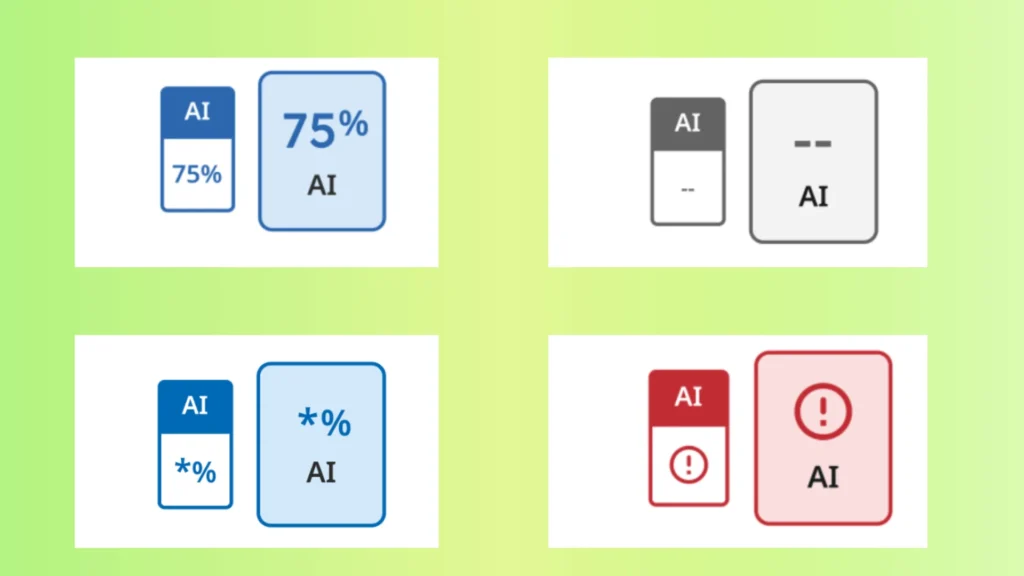
Turnitin provides functionalities for detecting AI-created writing for eligible submissions through compatible products and institutional settings. These functions assess if qualifying text might have been produced by AI writing tools.
AI detection differs from checking for similarity. A Similarity Report highlights matching text, while an AI writing indicator assesses the probability that specific text was produced using AI.
Both outcomes should not be confused with each other.
AI detection does come with its constraints. Text authored by humans may sometimes be erroneously flagged, and AI-generated content might not always be recognized. Turnitin advises educators against relying solely on the AI indicator for taking negative actions toward a student.
Students are advised to comply with their institution’s rules regarding AI usage, disclose its application when necessary, and retain drafts and research notes that document their writing process.
How to Interpret a Turnitin Similarity Report
Grasping the report can assist learners in pinpointing areas needing additional focus.
Begin by reviewing the total similarity percentage. Then investigate the individual highlighted sections and access the related sources when possible.
Reflect on the following inquiries:
Is the matching text an appropriately cited quote?
Does the text require a citation?
Is the paraphrasing sufficiently distinct?
Does the match derive from a bibliography or common terminology?
Does the passage conform to the referencing standards set forth in the assignment?
For instance, a correctly cited quote may still show as a match even though the student has accurately referenced it. Conversely, a section copied without proper attribution could raise red flags even if the overall similarity percentage is low.
Always evaluate the report within the given context and heed your instructor’s advice.
How to Enhance Your Academic Writing
Students can strengthen their assignments by cultivating effective research and writing practices prior to submission.
Express in Your Own Language
Digest the original content, comprehend its intent, and articulate the idea using your distinct vocabulary and sentence organization. Merely swapping a few words with synonyms does not suffice to produce a meaningful paraphrase.
Accurately Cite Sources
Acknowledge the contributions of others when utilizing their ideas, evidence, data, or exact language. Adhere to the citation style mandated by your institution, such as APA, MLA, or Chicago.
Include Original Analysis
A well-crafted assignment encompasses more than just a recapitulation of existing studies. It contrasts various perspectives, articulates the importance of the evidence, and links your results to the primary research inquiry.
Examine Your Manuscript
Before finalizing your paper, verify all quotes, citations, and references. If a Turnitin report is obtainable, analyze any matching sections and rectify real issues while preserving essential citations.
Maintain Research Documentation
Preserve outlines, drafts, source URLs, and pertinent notes. These materials can assist in structuring your work and clarifying how your concepts evolved if inquiries arise.
Is Turnitin Available Without Charge for Learners?
Access to Turnitin is contingent upon the educational institution, specific product, and subscription agreements. Numerous students utilize the service through their college’s educational platform or project submission system.
Students should not presume that all Turnitin functionalities are accessible via a personal account. To secure access, reach out to your instructor, academic department, or university library to inquire about available alternatives.
Prior to uploading non-published research or sensitive documents to an online platform, review the relevant privacy and submission guidelines.
You can obtain official details on the Turnitin website.
Common Inquiries Regarding Turnitin
Does Turnitin inherently identify plagiarism?
No. Turnitin detects similarities in the submitted content and existing resources. Educators need to examine the identified matches and decide if they signify plagiarism according to the relevant academic standards.
Is a 0% score on Turnitin an indication of originality?
No. A 0% score indicates that no reportable similarities were found under the corresponding conditions. It does not assure that all ideas are original or accurately referenced.
Can Turnitin recognize AI-generated writing?
Turnitin provides capabilities for detecting AI-generated content for qualifying submissions. Nevertheless, this feature may produce inaccuracies, thus its findings should be interpreted with caution.
Does a correctly cited quote increase the similarity index?
It can. Cited quotations that are accurately referenced might still show resemblance to their original sources. Whether such similarity is permissible varies based on the assignment criteria and institutional stipulations.
What steps can I take to enhance my Turnitin report?
Employ accurate citations, create substantial paraphrases, incorporate original analysis, and thoroughly examine matching segments. Abide by your institution’s criteria instead of aiming for a specific similarity percentage.
Conclusion
Turnitin serves as a valuable tool for evaluating text similarities, promoting ethical writing, and assisting instructors in delivering feedback. Its Similarity Report can pinpoint sections that require further scrutiny, and its AI detection features offer an additional measure for assessment.
Nonetheless, a similarity score does not inherently indicate plagiarism, nor does an AI detection result definitively prove the method of composition. Understanding context, proper referencing, and human interpretation remain crucial.
Students can optimize their experience with Turnitin by formulating original arguments, accurately citing sources, keeping comprehensive research notes, and thoughtfully addressing feedback. These practices enhance academic writing quality and foster authentic academic integrity.